
How to verify an e-cheque option before paying
 Available in US

The evidence does not confirm a UK casino offering e-cheques, so payment availability and account-level terms need checking directly.
What the available evidence can—and cannot—confirm about e-cheque
There is no confirmed UK casino to name as accepting e-cheques. That means acceptance cannot be presented as an established option for UK players, and a list of online casinos offering this payment route would imply more certainty than is available. If you are looking for a casino that accepts e-cheques in the UK, treat the method as unconfirmed until the individual operator explicitly identifies it as available to you.
This distinction matters because payment names can appear in general descriptions without establishing that a particular customer can use them. A reference to e-cheque elsewhere does not, by itself, show that a UK casino offers it, that it is available to UK accounts, or that it remains available at the point you intend to pay. Nor does a broad statement about electronic payments establish support for this specific route. The name needs to be tied to the operator and the customer’s actual account.
The same caution applies to requests for the best or top casinos that accept e-cheques. A ranking requires confirmed entries; without them, naming or ordering casinos would turn an uncertain payment claim into an apparent recommendation. No casino should be treated as an e-cheque option simply because it supports other forms of online payment or because a payment description sounds similar.
If you’re looking for a UK casino that accepts e-cheques, check that the payment method is currently available before you sign up. The details here provide a payout-speed reference, but do not confirm e-cheque acceptance.
-
Dieselwin
- Payout speed
- 1-3 business days
The listed payout speed is 1–3 business days. You’ll need to check directly whether e-cheques are accepted.
-
SpinFormula
- Payout speed
- 1-3 business days
The listed payout speed is 1–3 business days. You’ll need to check directly whether e-cheques are accepted.
-
EvoSpin
- Payout speed
- 1-3 business days
The listed payout speed is 1–3 business days. You’ll need to check directly whether e-cheques are accepted.
-
Amunbet
- Payout speed
- 1-3 business days
The listed payout speed is 1–3 business days. You’ll need to check directly whether e-cheques are accepted.
-
WinBeast
- Payout speed
- 1-3 business days
The listed payout speed is 1–3 business days. You’ll need to check directly whether e-cheques are accepted.
-
NightLuck
- Payout speed
- 1-3 business days
The listed payout speed is 1–3 business days. You’ll need to check directly whether e-cheques are accepted.
-
Zombillion
- Payout speed
- 1-3 business days
The listed payout speed is 1–3 business days. You’ll need to check directly whether e-cheques are accepted.
-
NightWin
- Payout speed
- 1-3 business days
The listed payout speed is 1–3 business days. You’ll need to check directly whether e-cheques are accepted.
-
Jetsetspins
- Payout speed
- 1-3 business days
The listed payout speed is 1–3 business days. You’ll need to check directly whether e-cheques are accepted.
-
BeOnBet
- Payout speed
- 1-3 business days
The listed payout speed is 1–3 business days. You’ll need to check directly whether e-cheques are accepted.
A named payment method is not evidence of every other method
UK-facing casino payment information can mention familiar routes such as Visa, Mastercard, bank transfers, e-wallets and cryptocurrencies. A specialist review, for instance, may describe several of those categories when summarising the payment methods it has examined. That kind of overview is useful as background, but it does not establish that every casino accepts every method in each category. It says even less about an unlisted route such as e-cheque.
This is why “electronic payment” is too broad a label to settle the question. A card payment, a bank transfer, an e-wallet transaction and an e-cheque may all be handled electronically, but that shared feature does not make them interchangeable. Support for one does not prove support for another. A casino’s mention of bank transfers, for example, cannot be read as confirmation that it accepts an electronic cheque.
Payment information can also change. A method may be added, removed or restricted, and general descriptions may not reflect the options available to a particular customer. Even a statement that was accurate at one time is not a guarantee of current access. For that reason, an old reference to e-cheque, or a description that does not clearly identify the UK service, is not enough to establish current acceptance.
What “unconfirmed” means for your decision
Unconfirmed does not mean that every operator has expressly rejected e-cheques. It means you should not rely on acceptance as a verified feature when deciding where to open an account or how to fund one. Keep the distinction precise: a payment route may exist in some context, but that does not establish its availability at a UK casino.
 Casinos That Accept EntroPay in the UK: How to CheckLearn how to verify EntroPay in a casino’s live cashier, compare payment costs and check how account and transaction details can affect…
 Casinos That Accept Revolut in the UK: Payment GuideLearn why a Revolut deposit showing in the cashier may still be excluded from a casino bonus, and what to check in…
The practical consequence is simple. Do not assume that an operator will accept an e-cheque because it accepts other payment methods, uses a general “online payments” label, or appears in a discussion of electronic banking. Look for an explicit statement that identifies e-cheque as a method supported for UK customers. If that statement is not available, regard the option as unresolved rather than treating the casino as a confirmed match.
This also avoids confusing the method with a similar-sounding service. Payment providers and casinos can use overlapping terms for different processes. A label that resembles “e-cheque” is not necessarily the same payment route. Unless the operator makes the connection clear, the wording alone cannot establish that the method you have in mind is supported.
The scope of this point is narrow: it concerns whether UK casino acceptance of e-cheque can be confirmed. It does not imply that UK casinos lack other payment options. Debit cards, bank transfers and e-wallets are separate routes, and information about them should be assessed on its own terms. Their presence does not prove e-cheque acceptance, just as uncertainty about e-cheques does not describe the availability of those other methods.
For now, the accurate answer to “Which UK casinos accept e-cheques?” is that none can be named as confirmed. Treat any specific claim as something that needs clear, current confirmation from the casino itself before relying on it.
How to check whether an online cashier supports your payment route
A payment method mentioned on a casino’s general information page is not necessarily available to every customer. The cashier is the place to check what the operator currently presents for your account. This distinction matters when you are looking for an e-cheque option: a general description of UK payment methods does not establish that a particular cashier offers it.
Start by signing in to the casino account and opening the cashier or payments area. Look for the section used to add funds, then inspect the methods displayed there. Do not treat a logo in a footer, an old promotional page or a third-party review as confirmation that the route is selectable. Those references may describe a wider service range, a past offering or a method that is not enabled for your account.
Check the cashier while using the same device and account you intend to use for the transaction. If you are looking for a mobile e-cheque casino, open the operator’s site or app on your phone and inspect its cashier directly. A mobile page may arrange payment options differently from a desktop page, so do not rely on a screenshot or description of another version. The relevant test is whether the method appears as an available choice in your signed-in cashier.

If the method is listed, read the accompanying label and any explanation before selecting it. A name may refer to a particular service or payment route rather than to every product that uses a similar term. Check that the displayed option matches the route you actually intend to use. If the wording is unclear, ask customer support to identify the exact method shown in the cashier. A response about a general category is less useful than confirmation tied to the option and account you are viewing.
Treat a payment option as unconfirmed if you cannot find it in the cashier. That does not prove it is unavailable to every customer; it means you should not proceed on the assumption that it is available to you. The cashier may change, and the options shown can depend on the operator’s current setup or the account being used. If you are uncertain, pause and ask the operator to clarify rather than choosing a different method that only sounds similar.
Checking Your Cashier
-
1
Sign in
Log into the casino account you plan to use on the intended device.
-
2
Access payments
Open the cashier or payments area and navigate to the section used to add funds.
-
3
Inspect methods
Search for the exact name of the payment route and read any accompanying labels or conditions.
-
4
Verify with support
If the route is absent or ambiguous, ask the operator to identify the exact method shown for your account.
The same check applies to familiar payment names. A specialist review may list Visa or Mastercard, but the current UK availability of a card route and whether your particular card product is eligible still need to be checked in the cashier. The name alone does not confirm that every card bearing it will be accepted. UK-licensed casinos cannot accept credit-card payments for gambling, so do not interpret a card logo as permission to use a credit card. Check the product type and the cashier’s terms before attempting a payment.
You can make the check more systematic:
- Sign in to the account you plan to use.
- Open the cashier and inspect its available payment choices.
- Search for the exact name of the route, rather than assuming that a related label means the same thing.
- Read any conditions displayed beside the option.
- If the route is absent or ambiguous, ask the operator whether it is available to your account before continuing.
Keep a record of what the cashier actually shows if you need to contact support. A screenshot can help identify the page and wording, but it is not a substitute for the operator’s answer if the availability is unclear. Avoid sharing passwords, security codes or other sensitive account information when asking for clarification.
Before making a deposit, also check that the casino is authorised to serve customers in Great Britain. Remote gambling licensees serving that market must hold the relevant UK Gambling Commission licence; you can confirm the licence number on the Commission’s public register. This is a separate check from payment availability: a method appearing in a cashier does not establish that the operator is licensed, and a licence does not mean that every payment route is offered.
For an e-cheque option in particular, the useful confirmation is specific: the cashier for your account displays an e-cheque route, or the operator clearly confirms that exact option is available to you. A general list of payment methods cannot answer that account-level question. If neither the cashier nor the operator can confirm it, do not treat the route as supported simply because a page describes it as a UK payment method.
What deposit and withdrawal support means in practice
A payment method can be available for deposits without being available for withdrawals. These are separate functions: a casino may be able to receive funds through a route but not send money back through it. Seeing a method listed in a deposit menu therefore does not establish that it supports both directions.
This distinction matters when you are looking for an e-cheque deposit casino in the UK. A description that mentions e-cheques, or a cashier that offers an e-cheque deposit option, would answer only whether that route can be used to fund an account. It would not, by itself, show whether the casino can return a withdrawal to the same e-cheque account. Treat deposit support and withdrawal support as separate claims.
The reason is practical as well as procedural. A payment route has an incoming side, through which the casino receives your deposit, and an outgoing side, through which it could return money. Those sides do not necessarily use identical processes. A provider might support one direction but not the other, or the casino might accept a route for deposits while directing payouts elsewhere. The name of a payment method is not proof of two-way compatibility.
That is why a list of casino sites that accept e-cheque deposits would not automatically tell you which sites support e-cheque withdrawals. For a complete picture, the cashier information needs to distinguish the transaction types. Look for wording that explicitly identifies deposits and withdrawals, rather than assuming that one label covers both. If the information describes only depositing, the withdrawal capability remains unresolved.
The distinction also applies beyond e-cheques. A payment method can be marked as deposit-only, which means it may put money into the casino account but is not available as the route for taking money out. In that situation, a different payout route may be offered or required. The existence of an alternative does not make the original method withdrawal-compatible; it means the transaction follows a different path.
Do
- Treat deposit and withdrawal support as separate claims
- Look for wording that explicitly identifies both transaction types
- Clarify with the casino if a route supports both directions
Don't
- Assume a deposit option automatically means withdrawal support
- Infer two-way compatibility from a general payment logo
- Treat the word "accepted" as proof of both-way support
For UK players, the payout path is also shaped by anti-money-laundering controls. Remote gambling operators commonly return funds to the payment source used for the deposit. This is a closed-loop control: it helps connect the money going out with the source from which it entered. It does not mean every payment method can receive a payout. The casino still needs a workable withdrawal route, and its stated rules determine which route can be used.
If a return to the original source is not possible, an alternative route may involve additional verification. That is a separate issue from whether the initial deposit succeeded. A successful deposit confirms that money reached the casino; it does not establish that a later withdrawal can be sent through the same channel or that another channel will be accepted without checks.
When assessing an e-cheque option, separate the questions rather than treating “accepted” as a complete answer:
- Can the method be selected for a deposit?
- Is it also listed as an eligible withdrawal method?
- If the casino requires funds to go back to their source, can this route receive that return?
- If a different route is needed, does the casino explain what applies?
These checks concern direction and compatibility, not the speed of either transaction. A deposit being credited promptly would not prove that a withdrawal can use the same method. Likewise, a stated withdrawal route would not prove that the method is available for deposits. Each capability needs its own confirmation.
If the cashier or terms do not make the distinction clear, avoid inferring two-way support from a payment logo, a general payment-method list or the word “accepted”. Ask the casino to clarify whether the specific route supports both deposits and withdrawals and what happens when a return to the original source is not possible. For e-cheque casino sites in the UK, that distinction is essential: a deposit option alone cannot establish that the method is suitable for the full path from funding an account to receiving a payout.
How to assess a payment route when no verified casino list is available
A casino list cannot tell you what a particular payment route will cost on your account. Charges depend on the terms applied by the casino, the payment provider and, where relevant, your bank or card issuer. To compare options, look at the actual payment terms and work out how each charge affects the amount you send or receive. Do not treat a route as the best choice simply because one fee is absent or not shown prominently.
A specialist payment review identifies several possible cost points: a casino charge, a fee from the payment provider, a charge from an issuer or bank, an exchange-rate spread and a network fee. These are separate parts of the transaction, and not every route will involve every type. The useful comparison is therefore not a generic ranking of payment methods, but a check of the costs that apply to the specific route and amount you intend to use.
Separate direct charges from conversion costs
Start with any fee stated by the casino. Check whether it applies to the transaction itself, whether it is deducted from the amount transferred, and whether the terms distinguish between payment routes. Then review the payment provider’s terms and any relevant bank or issuer charges. A casino showing no fee does not establish that the full payment is free: another party involved in the transfer may charge separately.
Next, check whether the transaction involves a currency conversion. A provider or bank can apply an exchange rate that includes a spread: the rate used for the payment may differ from a reference rate, with the difference affecting the value transferred. That cost may not appear as a clearly labelled fee. A visible flat charge can therefore be only one part of the total cost, and a route with no such charge may still transfer less value after conversion.
Network fees can also apply to some payment routes. If a fee is stated, include it in the comparison rather than treating it as unrelated to the payment. The relevant question is what leaves your account and what reaches the destination after all applicable charges—not just what the casino’s cashier displays.
Compare like with like
A useful comparison holds the intended transaction amount constant. For each route, note the casino’s stated charge, any provider or bank fee, any network cost, and whether conversion takes place. Then establish the amount that will be debited and the amount that will be credited. If a charge is deducted from the transfer rather than added to it, the credited amount may be lower; if it is added separately, the total debit may be higher.
Check the wording carefully. A fee may be described as applying to a transaction, while another cost is built into the exchange rate. Terms may also identify the party that sets the rate or collects the charge. If the information does not make the calculation clear, ask the relevant provider or casino to explain it before submitting the payment. Do not fill gaps with assumptions based on another site or another payment route.

The same comparison method applies when assessing an e-cheque option. First establish the terms that would apply to that exact route; do not infer its cost from a different bank transfer, card payment or e-wallet. If no fee information is available, the cost cannot be reliably ranked against alternatives. That is different from proving that a charge exists: it means you do not yet have enough information to calculate the total.
There is no universally lowest-fee payment method. The result depends on the charges applied to the actual transaction, including any conversion spread and network cost. A careful comparison considers the full debit and credit figures together, rather than selecting a route from a headline fee alone.
The payment account and the casino account must line up
A payment can be associated with a customer only if the details on the casino account and the details attached to the payment route make sense as belonging to the same person. When they do, basic ownership checks are less likely to create avoidable friction. When they do not, the operator may need to resolve the discrepancy before it can treat the transaction as straightforward.
This is relevant whenever you consider an e-cheque or another payment route. The method itself does not establish who owns the account used to send funds. The casino account and the payment account are separate records, and an operator may compare their customer details when reviewing a transaction. A payment route being visible in a cashier would not, by itself, settle an ownership mismatch.
Before making a payment, check that the casino account is registered with your own accurate details and that the payment account is also yours. If information differs, do not assume the difference will be ignored or automatically corrected. Check the operator’s instructions or ask its support team what it needs before you proceed. This is a practical way to avoid a preventable interruption; it does not guarantee that a transaction will be accepted.
The same principle applies if an e-cheque service uses an account or profile with details that are not clearly connected to you. A difference may have an innocent explanation, but the operator cannot infer that explanation from the payment alone. It may ask for further information to establish the link. That can add steps even when the funds were sent successfully.
Keep the distinction clear: matching ownership details can reduce friction, but it cannot confirm that a casino accepts e-cheques, or that a particular payment route will work for your account. Those are separate questions. Treat consistent details as a basic preparation step, not as proof of payment-method support.
If you share access to a payment account, or use one held in another person’s name, pause before using it. The transaction may not clearly identify you as the account holder, and that can complicate routine checks. Using a payment route and casino account that both belong to you gives the operator a clearer basis for matching the customer to the transaction.
Deposit amounts and account-level financial limits
The minimum deposit is not necessarily the same across payment methods. A specialist review reports that stated minimums start within the £10–£20 range, depending on the method selected. Treat that as a reported range, not a universal rule: the amount shown for a particular route may differ, and you should check the cashier and the operator’s terms before deciding how much to deposit.
The minimum is only one part of the limit structure. A payment route may have a maximum for a single transaction, while the casino may also apply daily or monthly deposit caps. A specialist review notes that these maximums vary with the payment method and the customer’s account status. That means a method’s transaction cap and your own account-level controls are separate constraints: the amount accepted can be affected by either one.
If you are considering an e-cheque, do not assume that a minimum or maximum published for a card, bank transfer or another route applies to it. The relevant figures are the ones explicitly shown for the method available to you. A displayed limit is more useful than a general statement because it relates to the selected route and your account.
Financial limits also serve a different purpose from payment-method caps. UK Gambling Commission rules require remote gambling licensees to prompt new customers to set a financial limit before their first deposit. They must also provide accessible controls for setting limits at account level. These controls let you define a boundary for your gambling account; they do not change the payment provider’s own transaction restrictions.
Understanding Deposit Limits
Minimum deposits often range between £10–£20 depending on the method. However, you must also consider single transaction maximums and account-level daily or monthly caps set according to UK Gambling Commission rules.
Before depositing, distinguish the amount you intend to send from the maximum the payment route will accept and from any account limit you have set. If the cashier rejects an amount, check whether it exceeds the route’s stated cap or conflicts with an account-level control rather than repeatedly submitting the same transaction. Keep the limit you choose within an amount you can afford to lose, and use the account controls to restrict deposits if that helps you stay within your budget.
Why a deposit can clear before a withdrawal arrives
A deposit and a withdrawal pass through different stages, so the time taken for one does not predict the time taken for the other. A deposit is credited when the casino receives confirmation that the incoming payment has been accepted. A withdrawal, by contrast, may need the casino to approve the request before it is sent for payment.
That internal approval is one reason money can appear in your casino balance before a payout reaches your account. The operator may need to review the withdrawal and confirm that your account has completed verification. If checks remain outstanding, the request can stay at the casino’s stage rather than progressing to the payment stage. Once it is approved, delivery still depends on the route used.
A specialist review describes card deposits as potentially instant while a payout can take several business days. That contrast illustrates the difference between crediting an incoming payment and completing an outgoing one; it is not a timetable that applies to every casino or transaction. The casino’s approval process and whether your account is fully verified also affect withdrawal speed.

You can make the stages easier to distinguish by checking the status shown for the transaction. A request marked as pending or under review has not necessarily been sent to the payment provider yet. A request shown as processed may have left the casino, while the receiving account may still be waiting for it. The wording varies between operators, so check the cashier or transaction history for the status definitions used by that casino.
If a withdrawal is taking longer than expected, first establish whether it is awaiting casino approval or has already been released. Then check whether the casino has asked you to complete verification. Those details help identify whether the delay is within the operator’s review or after release, without treating a quick deposit as evidence that a payout will arrive at the same speed.
Check the currency before you send a payment
A payment route and the currency of your casino account are separate settings. Before depositing, check which currency the account uses and what currency the cashier will charge. A specialist casino review reports GBP support on the services it assessed, but that does not establish the setting for every casino or every account. Confirm it in the cashier before your first transaction.
If your casino balance and payment account use different currencies, the transaction may be converted. The amount debited from your bank or payment account can then differ from the amount credited to your casino balance. The reverse can also matter when funds are converted back: the amount received may not match the amount originally deposited.
Check which party performs the conversion. The casino, payment provider, bank or card issuer may apply its own exchange rate or charge. A specialist review notes that the conversion spread—the difference between the rate applied and a reference exchange rate—can cost more than a visible flat fee. A fee shown as zero therefore does not prove that a transaction has no currency cost.
Before confirming a payment, read the cashier’s displayed currency and any conversion information. If the casino account is set to GBP and the payment source is also denominated in GBP, that particular conversion may be avoided; other charges can still apply. If the currencies differ, compare the rate and any stated fee before proceeding, and check whether your provider may apply a separate charge.
This check applies whatever payment route you are considering, including an e-cheque option if one is presented. Do not infer currency support from the payment method’s name: verify the currency shown for your own account and transaction.
How the original payment source affects withdrawals
A withdrawal does not always go to whichever destination you select at the time. UK anti-money laundering controls commonly require funds to be returned to the original payment source. This is a closed-loop approach: the route used to fund the casino account also shapes where a payout can be sent.

That rule can affect your plans if you expect to deposit through one method and withdraw through another. A casino may need to send funds back through the original route, or ask you to complete additional checks before considering an alternative. Those checks help establish that the requested payout destination is legitimate; they do not mean that every alternative route will be accepted.
The simplest arrangement is often to use one named payment account consistently for deposits and withdrawals. Before making a deposit, read the casino’s withdrawal terms for instructions about returning funds to the source and what happens if that route cannot receive a payout. If the wording is unclear, ask customer support to explain the process for your specific payment method.
Treat an e-cheque as an unconfirmed route unless the casino’s own cashier and terms explicitly show it as available. Even if a payment method appears in a general description, that does not establish how withdrawals are handled. Confirm both the deposit route and the payout path before sending money, and keep any transaction records in case the casino asks you to explain the original source.

If the casino requests extra verification for an alternative destination, provide information through its stated secure process. Avoid assuming that a different account can be substituted without review: the original-source requirement is a control on the movement of funds, not merely a preference you can change when requesting a withdrawal.
What to verify before using a newly encountered payment option
A payment method mentioned in a casino description is not necessarily available for your account. Before making a first transaction, sign in and check the cashier: confirm that the option appears for your account and can be selected for the transaction you intend to make. This matters especially for e-cheque. A reference to a newly encountered casino or payment option does not establish that the cashier supports it.
Check the account currency at the same time. A specialist casino review reports that GBP is supported, but that does not confirm the currency setting on your own account. If the account is set to another currency, a payment could involve conversion. Confirm the currency shown in your account and the amount the cashier will charge or credit before you authorise anything.
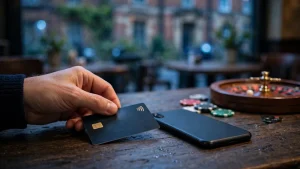
Treat the cashier’s displayed terms as specific to that account and transaction, rather than assuming that a general payment-method description applies to every customer. If an option is absent, unavailable for the intended transaction, or shown with unclear currency information, pause and ask the operator to clarify before proceeding. Do not rely on a payment route appearing in an older description as proof that it is currently offered.
This check is useful whenever you encounter a method you have not used at that casino. It separates three distinct points: a method may be mentioned, it may appear in the cashier, and its currency may be suitable for your account. Confirming the latter two before sending funds helps you avoid acting on an assumption about either availability or conversion.
Why must withdrawals return to the deposit method?
Returning funds to the original payment source is a common anti-fraud and anti-money-laundering control. An alternative payout route may require extra verification.
What is the fastest withdrawal method for UK casinos?
PayPal, open banking services and debit cards linked to fast payout systems are generally among the quickest. Your payout can still take longer if the casino needs to approve it or verify your account.
Are fast casino withdrawals guaranteed?
No. Withdrawal speed depends on the casino’s approval process and whether your account is fully verified.
What is the current minimum deposit?
The minimum usually starts at £10–£20, depending on the payment method you choose.
Which payment methods are accepted in Great Britain?
Common options include Visa and Mastercard debit cards, bank transfers, e-wallets and, at some sites, Apple Pay. Paysafecard is for deposits only; check the cashier for methods available to your account.
Are Visa and Mastercard deposits definitely debit cards?
No. Visa and Mastercard identify the card network, not necessarily the card type. Check your card’s eligibility and the casino cashier; credit-card gambling has been banned in the UK since 14 April 2020.
Payments at UK Casinos: Methods Compared
Content created by the «myessayhelper» team